Top 7 transportation management systems (TMS) for small carriers
Is your fleet operating at peak efficiency? Find out how TMS can optimize your operations and boost your bottom line.

By Geotab Team
Sep 14, 2026
Key Insights
- TMS software centralizes accounting, dispatch and operations for transportation companies — reducing manual tasks and enabling data-driven decisions across the entire fleet.
- U.S. trucks move 11.46 billion tons of freight annually, making efficient load planning, carrier management and route optimization critical to profitability.
- With operating costs reaching $2.25 per mile, TMS software reduces overhead by automating dispatching, invoicing and compliance tracking in a single platform.
- When integrated with Geotab's MyGeotab telematics platform, TMS software adds real-time GPS visibility, driver behavior data and fuel monitoring to complete the operational picture.
Transportation management systems have become the operational backbone of modern fleet businesses. TMS for small carriers can be especially valuable, helping lean teams reduce manual work in areas like dispatching and billing. The right platform can support operations ranging from over-the-road trucking to specialized transportation with automated workflows and real-time data.
Paired with Geotab's telematics platform, a transportation management system software integration gives fleet managers a unified view of every asset, driver and shipment, from departure to delivery. The seven solutions below are available directly through the Geotab Marketplace and cover a wide range of fleet types and operational needs.
Key features for your transportation management system
Unlike fleet management software, which focuses on vehicles and drivers, a TMS manages workflows, like dispatching and billing. Connecting the two can help you optimize your telematics platform. Small businesses should prioritize affordability and ease of use, while enterprises may need greater customization.
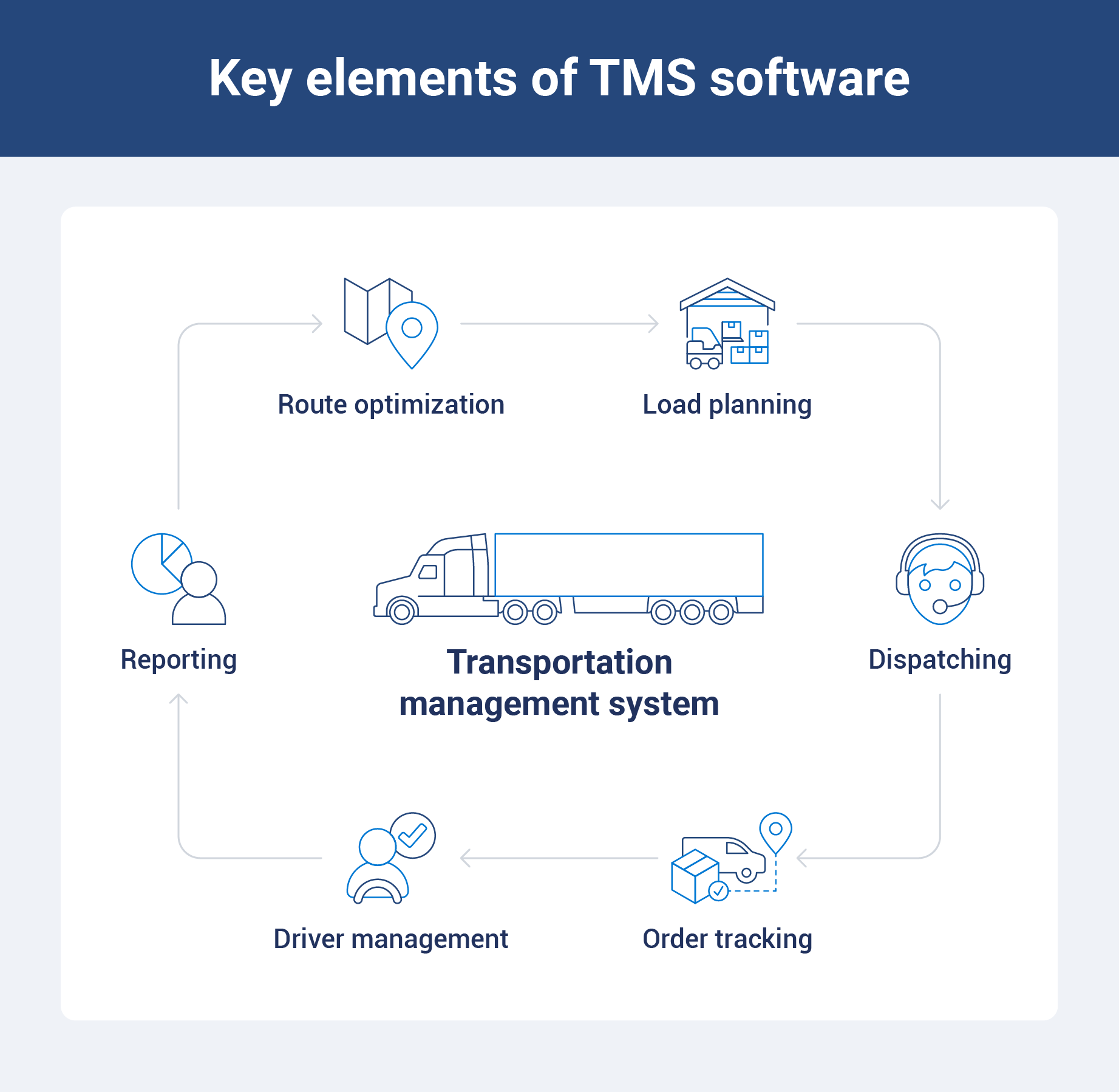
Route scheduling and tracking
Factors like traffic, customer availability and unforeseen delays constantly influence route efficiency. With escalating fuel and maintenance costs, fleet route optimization has never been more crucial in fleet management.
Dispatch and routing tools can help streamline transportation logistics with long-range planning, location intelligence and real-time dispatching features.
Freight management
According to recent trucking statistics, U.S. trucks move 11.46 billion tons of freight annually. Moving goods requires closely managing costs, rates and billing needs, which can be time-consuming and difficult to predict.
The right TMS software can help optimize this process by offering task assignments, automated order entries and invoicing in one place.
Fleet management
Think of TMS software as a central hub for all your fleet management-related data and tasks. GPS tracking provides real-time visibility into vehicle location, allowing for better route planning.
Additionally, fuel management tools help monitor fuel consumption, identifying areas for improvement.
For example, a TMS can help identify a vehicle that consistently uses more fuel than others. This could indicate a maintenance issue, a driver behavior problem or an inefficient route.
Carrier management
Effective carrier management is essential for ensuring smooth and cost-effective transportation operations. TMS software helps streamline interactions with carriers, from onboarding to payment processing.
With a database of carrier information, including rates, service areas and performance history, you can quickly identify the best carrier for a particular shipment based on factors like cost, transit time and reliability.
Role-specific functionality
A robust TMS caters to the diverse needs of various roles within a trucking company. Here's how different functionalities can benefit specific roles:
- Owner-operators: Load planning, route optimization and expense tracking help independent owner-operators maximize their profitability.
- Fleet managers: Vehicle diagnostics and maintenance scheduling tools allow fleet managers to monitor vehicle health and optimize performance.
- Logistics managers: Demand planning, network optimization and reporting features provide the insights logistics managers need to improve supply chain efficiency.
- Leased operators: Integration with dispatch systems and automated invoicing features streamlines operation, making it easier to manage trips.
- Freight brokers: Load matching, carrier sourcing and rate management tools help freight brokers connect shippers with carriers quickly and efficiently.
- Dispatchers: Real-time visibility, communication tools and automated dispatching features enable dispatchers to optimize routes, assign loads and communicate effectively.
- Drivers: Mobile apps with navigation, electronic logging device (ELD) integration and delivery confirmation features simplify drivers' tasks and improve communication.
Ease of use
A steep learning curve can slow down small carriers without dedicated IT support. Look for a TMS with an intuitive mobile app and a straightforward setup process. Responsive customer support is also important for resolving issues without disrupting daily operations.
Integrations
A TMS should connect with the tools your business already uses, including ELD providers and accounting platforms, like QuickBooks. Connections to load boards such as DAT and Truckstop can help small carriers find freight, while connections to factoring companies can help them get paid faster. These connections reduce duplicate data entry and keep information consistent across systems.
Pricing and scalability
TMS providers may charge a flat monthly rate, a per-truck fee or offer a limited freemium tier. Compare the total cost and check how pricing changes as your fleet grows. Small carriers should choose a platform that meets their current budget without requiring costly upgrades for each new truck.
Best TMS options
The best TMS systems depend on your fleet size and the types of freight or transportation services you provide. Budget also matters, especially for smaller operations that may not need the complexity of an enterprise platform.
The following comparison is a practical starting point rather than a rigid ranking. These top transportation management systems for small carriers and specialized fleets address different operational needs, from general freight dispatching to liquid bulk hauling.
| Tool | Top features | Ideal for |
| LoadMaster | HOS visibility, two-way driver communication, live tractor tracking and load planning | Common carriers that need dispatch tools and a customer portal integration |
| Enrich Software | Asset-level reporting, flexible billing, warranty tracking and automated fuel tax processing | Lease and rental companies, private fleets and common carriers |
| Rose Rocket | Flexible dispatching, driver scheduling, real-time tracking and a customer self-service portal | Common carriers that want a cloud-based TMS with customer portal access |
| Magnus TMS | Load optimization, real-time shipment visibility, driver management and mobile dispatch | Truckload and LTL carriers that need an end-to-end mobile dispatch solution |
| TrueLiquid | Commodity management, dynamic route optimization, load forecasting and customer tracking | Liquid bulk haulers with specialized routing and load-management needs |
| TrueFleet | Order automation, load planning, driver settlements and customizable reporting | Small to medium-sized fleets looking to automate transportation tasks |
LoadMaster
Ideal for: Over-the-road trucking companies in the U.S. and Canada.
LoadMaster is a comprehensive trucking dispatch and accounting software. With the integrated McLeod Driver App, this TMS offers features like settlement viewing, document capture, mobile communication and collision reporting for improved efficiency, compliance and customer service.
Top features:
- Real-time driver hour tracking: Automatically and continuously updates driver hours and duty status throughout the day
- Proactive HOS updates: Schedules automated calls to drivers for timely updates to their Hours of Service (HOS) logs
- Integrated HOS visibility: Integrates driver hours data into LoadMaster's Dispatch Order Planning and Driver Management modules
- Enhanced communication: Facilitates efficient two-way communication between drivers and dispatchers
- Live tractor tracking: Provides real-time updates on tractor locations, visible across multiple modules
- Enhanced load planning: Improves load planning and execution by providing accurate ETAs and identifying out-of-route deviations
Provided by: McLeod Software
Enrich Software
Ideal for: Full-service lease and rental companies and private and common fleets.
Enrich Software empowers fleet managers to optimize operations and maximize profitability across various sectors, including full-service leases, rental companies, private fleets and dedicated carriers.
Top features:
- Detailed asset-level reporting: Analyze factors like utilization, maintenance costs and fuel consumption to optimize resource allocation
- Flexible billing management: Tailor contracts with diverse billing options to cater to specific customer needs
- Part-specific tracking: Track warranties by individual parts, ensuring you receive total compensation for eligible repairs and reducing maintenance costs
- Fuel tax processing: Automate the tedious task of fuel tax processing, freeing up time and minimizing the risk of errors
- Integrated mobile app: Access key data, assign tasks and stay connected to your team from anywhere
Provided by: Enrich Software Corporation
Rose Rocket
Ideal for: Common carriers looking for a customer portal integration.
Rose Rocket is a cloud-based Transportation Management System (TMS) designed to help carriers of all sizes protect their business. It offers a suite of features that simplify and automate tasks across the shipping lifecycle.
Top features:
- Order management: Create, manage and filter orders with ease
- Flexible dispatching: Efficiently dispatch LTL, FTL, single-stop or multi-stop route deliveries
- Intelligent driver scheduling: Optimize driver assignments based on availability and HOS
- Driver mobile app: Empower drivers with real-time information and task management
- Customer self-service portal: Provide customers with a secure order tracking and document management portal.
- Visual dispatching: Plan and track orders visually on an interactive map
- Real-time tracking: Monitor shipments in real time and provide accurate ETAs
- Multicurrency support: Seamlessly handle USD and CAD transactions
Provided by: Rose Rocket
Magnus TMS
Ideal for: Common carriers looking for an end-to-end mobile dispatch solution.
Magnus TMS is a SaaS-based TMS software for carriers that offers a comprehensive solution for truckload and LTL fleets. Magnus TMS empowers your dispatch and drivers to deliver on time, comply and provide full visibility into the shipment process.
Top features:
- Load planning and optimization: Maximize profitability and meet customer service requirements with advanced load planning tools
- Real-time visibility: Monitor shipments in real-time, track driver performance and provide accurate ETAs to customers
- Driver management: Optimize driver schedules, manage HOS compliance and improve driver satisfaction
- Integrated carrier network: Connect with a network of carriers to optimize freight movement
- Customer portal: Provide customers with real-time visibility into their shipments
- Mobile app: Empower drivers with real-time information and task management tools
- Advanced routing and dispatch: Optimize routes and improve delivery efficiency.
Provided by: Magnus Technologies
Treker
Ideal for: School districts looking for real-time bus tracking.
Treker is a school transportation platform that provides real-time bus tracking and communication tools for school districts, parents and drivers.
Parents can monitor their child's bus rides, receive notifications and know when to expect the bus. Treker's quick implementation helps schools improve student safety and efficiency.
Top features:
- Flexible pricing: Offers flexible options, free trials and shorter contracts, making it affordable to implement
- Transportation contractor portal: Maintain oversight of contracted transportation services, reducing administrative burden for the district
- Real-time tracking: The admin portal offers real-time tracking of the entire bus fleet and student ridership visibility
- Parent app: Provides real-time bus arrival notifications, student check-in and check-out alerts and trip tracking
- Driver tablet: A mounted driver tablet offers real-time route information, ease of communication and NFC reader integration for safe transportation
Provided by: Treker, LLC
TrueLiquid
Ideal for: Liquid bulk haulers looking to streamline operations.
TrueLiquid is a cloud-based transportation management system designed specifically for liquid bulk haulers. TrueLiquid offers features like commodity management, dynamic route optimization and load forecasting.
With its customer portal, mobile app and AI-powered tools, TrueLiquid streamlines operations and enhances efficiency for liquid bulk haulers of all sizes.
Top features:
- Commodity management: Efficiently manage various liquid commodities and tank compartment allocation
- Dynamic route optimization: Optimize delivery routes based on real-time traffic and vehicle sensors
- Load forecasting: Accurately predict future liquid cargo demands with TrueCast
- Customer portal: Provide customers with real-time shipment tracking and updates
- Mobile app: Empower drivers with real-time information and task management
- Advanced reporting and analytics: Gain valuable insights to optimize operations
- Scalable and customizable: Adapt to your business needs as you grow
Provided by: True TMS
TrueFleet
Ideal for: Small to medium-sized fleets looking to automate transportation tasks.
TrueFleet is a user-friendly cloud-based transportation management system tailored for small and medium-sized fleets. It streamlines operations by automating tasks like order management, payroll and maintenance scheduling.
Top features:
- Order lifecycle automation: Automate routine tasks like rating loads, importing orders and tracking shipments
- Intuitive load planning and dispatch: Efficiently plan and assign loads to drivers
- Driver pay and settlements: Automate driver payroll and settlement calculations
- Real-time tracking: Monitor shipments with real-time GPS tracking
- On-demand reporting and analytics: Gain valuable insights with customizable reports
- Mobile app: Empower drivers with real-time information and task management
Provided by: True TMS
Benefits of using TMS software
TTransportation management systems offer a robust solution by automating tasks, centralizing data and providing real-time insights. With operating costs reaching $2.25 per mile, TMS software can also help minimize costs by increasing efficiency.
TMS for small carriers can provide these benefits without the complexity of an enterprise system. By reducing manual work, the software allows small teams to manage growing operations with their existing resources.

Here's how TMS software can benefit your transportation business:
- Increase efficiency: TMS software automates tasks like route planning, dispatching and load optimization, freeing up valuable time and resources for your team. This can translate to faster delivery times, improved on-time performance and increased overall throughput.
- Enhance visibility: Real-time tracking of drivers, vehicles and shipments provides complete transparency for your transportation network. You can monitor progress, identify potential delays and proactively adjust schedules to facilitate timely deliveries.
- Support compliance: TMS software helps you stay compliant with complex transportation regulations, such as Hours of Service (HOS) for drivers. Automated alerts and reminders can help reduce compliance issues that result in costly fines and delays.
- Boost ROI: Streamlined operations, reduced errors and improved delivery efficiency contribute to a higher return on investment (ROI). TMS software can significantly improve your bottom line by optimizing fleet costs associated with fuel, tolls and carrier selection.
- Optimize cost management: Gaining real-time insights into transportation costs allows for better decision-making. You can identify areas for cost savings, negotiate more favorable rates with carriers and optimize fuel usage with efficient route planning.
Who needs a TMS?
TMS software is useful for carriers that have outgrown manual processes or need a clearer view of daily operations. For small businesses, it can reduce administrative work and keep important information in one place as load volume and fleet size increase.
Signs you are ready for a TMS
You may be ready for a TMS if you spend more than five hours each week on paperwork or manage three or more trucks using disconnected systems. Delayed invoices and disorganized driver compliance records are other signs that manual processes are no longer sufficient. A TMS can streamline these workflows and make it easier to manage growth.
When you may not need a TMS yet
Manual tracking may be sufficient for a single-truck owner-operator serving one customer on a dedicated lane. New carriers with limited freight volume may also benefit from establishing consistent workflows before investing in new software. Once administrative work becomes difficult to manage, a TMS may be worth considering.
How to choose the best TMS
The best TMS should address your carrier’s current operational challenges without adding unnecessary cost or complexity. Small businesses should focus on essential capabilities and choose software that can scale as load volume increases.
When comparing TMS options, consider:
- Features: Prioritize tools that improve your most time-consuming workflows, such as dispatching or invoicing.
- Ease of use: Look for an intuitive system that drivers and office staff can learn without extensive training.
- Integrations: Confirm that the TMS connects with your existing ELD and accounting software.
- Total cost: Account for setup fees and monthly charges, including costs that may increase as you add trucks.
- Customer support: Check when help is available and how quickly the provider responds to technical issues.
- Scalability: Choose a platform that can support additional loads or users without requiring an immediate upgrade.
Testing the platform with a typical load can help you determine whether it fits your daily workflow. Request a demo or free trial before committing.
Manage your small fleet with the right TMS
Is your fleet operating at its peak, or are inefficiencies and hidden costs eating away at your profits? Integrating a TMS software solution with Geotab's powerful telematics platform allows you to streamline your transportation and cold chain logistics, improve efficiency and boost your bottom line.
From real-time tracking and route optimization to automated dispatching and driver management, gain unparalleled control and visibility over your operations.
Small businesses and large enterprises can find TMS solutions in the Geotab Marketplace that fit their specific needs and support their business goals. Ready to take your fleet performance to the next level?
Subscribe to get industry tips and insights
Frequently Asked Questions
The best TMS for small carriers is one that fits the company’s budget, fleet size and daily workflows. Look for an easy-to-use platform with essential features, transparent pricing and integrations with your existing tools.
A transportation management system is software that centralizes dispatching, load planning, carrier management and financial operations for transportation companies. It automates manual tasks and provides real-time visibility into shipments, drivers and costs.
A fleet management system like MyGeotab focuses on vehicle and driver data: GPS tracking, fuel monitoring, driver behavior and maintenance. A TMS manages the business side of transportation: load planning, dispatch, billing and carrier relationships. Together, they provide complete operational and financial visibility
No, TMS is not an ERP system. TMS specifically manages transportation and logistics operations, whereas ERP is a broader system that integrates various business functions, like finance, HR and supply chain management.
TMS focuses on the movement of goods, including transportation planning, execution and optimization. WMS focuses on the storage and retrieval of goods within a warehouse or distribution center, including inventory management, order fulfillment and warehouse labor management.
TMS pricing for small carriers varies by provider, fleet size and included features. Some providers charge a flat monthly rate, while others use per-truck or per-user pricing. Carriers should also check for setup fees and integration costs before choosing a platform.
Yes. A one-truck owner-operator can use a TMS to reduce administrative work and keep load information organized. However, the cost may not be worthwhile for a simple operation with consistent lanes and minimal paperwork.
The Geotab Team write about company news.
Table of Contents
Subscribe to get industry tips and insights
Related posts

6 benefits of an open, AI-powered fleet data platform
September 17, 2026
8 minute read

The failure you didn't predict is more than just a repair bill
August 18, 2026
1 minute read

How dispatch management software contains the compounding costs of a sick call
August 10, 2026
3 minute read

Beyond location: How asset trackers measure equipment utilization
August 4, 2026
3 minute read
Beyond consumer apps: 5 ways integrated navigation protects your fleet
July 23, 2026
6 minute read

Closing blind spots in cargo security with a 360 fleet camera system
July 22, 2026
3 minute read